Showing posts with label technology. Show all posts

Saturday, August 7, 2010

Solar Activity and the Risks to Modern Technology

In the middle of our solar system sits a incredibly large nuclear reaction held together by an enormous gravity pull.

Many millions of times the mass of the earth, this star emits solar weather that stretches out past the orbit of Pluto.

As with weather on earth, the sun's weather can form destructive storms that stretch out from the sun's surface onto the Earth and further into the solar system.

Solar activity and storms

These solar storms are full of particles (protons, electrons, and plasma), radio waves, x-rays and other forms of energy that come from nuclear reactions.

When these storms reach Earth, they can having varying effects on our planet.


What does this have to do with Technology?

Most technology systems, with the exception of the military and some corporate technology, have no built-in resistance to the effects of extreme solar storms.

This means that most of our electronic devices, electric motors and power systems are very vulnerable to solar activity, which may render the devices partially or totally inoperable.


Why Should we be Worried About the Effect on Everyday Technology?

On September 1–2, 1859, the largest recorded geomagnetic storm occurred.

Aurorae were seen around the world, most notably over the Caribbean; also noteworthy were those over the Rocky Mountains that were so bright, the glow awoke gold miners, who began preparing breakfast because they thought it was morning.

Telegraph systems all over Europe and North America failed.Telegraph pylons threw sparks and telegraph paper spontaneously caught fire.

Solar activity and storms

Some telegraph systems appeared to continue to send and receive messages despite having been disconnected from their power supplies.

This storm was called the Carrington Event and similar strength storms reach the earth every few hundred years.

A storm like the Carrington Event today would cause most of our modern technology to fail within hours. There would be significant electronic damage, power failures, global financial confusion, and disruption to transport and communications.

Without active help and intervention, areas of the earth could experience famines, civil unrest, and wars.


Recent Solar Storms and Increasing Activity Causing Increased Risk

On the 3-5th of August, we had a geomagnetic storm interact with the Earth, causing a G3 storm event to our magnetosphere.

This storm was impressive, but lucky not a threat to most communication and power systems. However, it posed large issues for satellite operators and space operations.


G3 Solar Storm Effects:

Power systems:  voltage corrections may be required, false alarms triggered on some protection devices.

Spacecraft operations: surface charging may occur on satellite components, drag may increase on low-Earth-orbit satellites, and corrections may be needed for orientation problems.

Other systems: intermittent satellite navigation and low-frequency radio navigation problems may occur, HF radio may be intermittent, and aurora has been seen as low as Illinois and Oregon.

Solar activity and storms

All the definition for the scales of geomagnetic storms, solar radiation storms, and radio blackouts levels are located at the NOAA (National Oceanic and Atmospheric Administration) website. http://www.swpc.noaa.gov/NOAAscales/index.html

NOAA also has a website devoted to monitoring solar storm activity and contains other excellent information on solar activity. http://www.swpc.noaa.gov/

This current solar cycle is showing signs of the beginning of a very active period for solar storms and risks to the earth.

This cycle will continue to increase in activity for several years before subsiding into a calmer part of the cycle.


What to do About the Risks of a Solar Storm?

The issue needs to be treated like an natural event, similar to earthquake risks.

As with earthquakes on Earth, we have built better buildings, invest in detection and prediction, educating people and designing government polices to deal with such a disaster.


Solar activity and storms
Just with earthquake risk management, solar storms need to be addressed to minimise the harm to our way of life.

Possible improvements to solar flare storm risks:
  • More EM shielding in electronics devices
  • Better designed power systems and grids.
  • Better warning and forecast of solar storms
  • Understand the sun and it's dynamics better.
  • Education of people on the topic in a meaningful way.
  • Government polices on the issue, risks and reactions to events.

Through education of the public, better understanding of the sun and laws requiring built-in protection for important devices and systems, the world can become resistant to this type of event.

We may never be able to remove the risk of solar storms, but we can minimise its harm to our technology driven world.

Saturday, July 31, 2010

New Section in Scribd and the Natural Revolution

A new section in Scribd.com has been added to the Burning the Midnight profile.

Two articles have been uploaded to the Technology and Business collection for the new section.
  • Technology, Natural Capital and and the Natural Revolution Slides  
  • Innovation of Technology in Business Slides
 
Here is an embedded slide-show on Natural Capitalism and Revolution from the Burning the Midnight Scribd profile.


Watch the profile http://www.scribd.com/burningthemidnight for recent publications from Burning the Midnight, and further insights and information on technology, business, economy, security and environmental topics.

Wednesday, July 28, 2010

Solar Grid Inverter Monitoring System - Part 1

Solar based power has become an important part of modern strategy for some organisations as they move from carbon based fuel dependence to renewable energy.

One of my current projects is looking at a solar power applications for a school that is working towards establishing a carbon neutral power system.


Solar panel array for power

The solar panel array that is currently installed on the school's roof has enough panel area to produce up to 5 kilowatts of electrical power on a sunny day.


Fronius Grid Inverters
 

Grid inverters for solar power
Three Fronius Grid Inverters
Three Fronius IG 30 grid inverters can feed up to 7.5 kilowatts of power back into the grid, or to the school's AC electrical systems.

These high power inverters form the centre of the photovoltaic system, as AC power and access back to the power grid is essential at the school.


Grid inverters are essential for a power system to have mains AC power and photovoltaic power, enabling seamless use of both power sources as a single power source.


The goal of this project is to network the Fronius inverters into a PC system running MS Windows, so that information about the power grid and photovoltaic solar array can be collected for educational and organisational use.


Cabling the Grid Inverters for Computer Monitoring

Grid inverters for solar power
Inverter, fuse box and Cat5 plate

Grid inverters for solar power
Blue cables are the serial bus

The three Fronius grid inverters have been mounted on the wall in a way that makes it easy to network the units together.

The three inverter units all have special Com cards, so they can be networked together in a bus type network.

At each end of the Cat5 bus network, special terminator plugs are used to close circuit on the network.


Grid inverter network for monitoring
Grid Inverter Bus Network and PC Serial Connection


The last unit has a special data logger card that gives the Fronius grid inverters a data IO port for a computer via RS232.

The data logger card has a DB9 connector, which has been then converted to Cat5 for easy of use in the networking cabinet. 


Grid inverter network for monitoring
RJ45 connector in the rack to the Data Logger

The cable run from the DB9 connector on the inverter can be up to 20 metres in length.

But for longer lengths of cable, RS232 extenders maybe required.

For this example, the Cat5 serial cable is terminated into the network rack in another building.

The Windows PC is connected to the terminated rack connection, which connects back to the Fronius grid inverters with which the Windows PC will be communicating.


For part 2 of this project, I install and setup the Fronius IG access software on the Windows PC.

I will also be explaining the features and advantages that computerised power monitoring can have for an organisation.

Stay tuned.

Monday, July 26, 2010

Technology, Natural Capital and The Natural Revolution

Technology and business have always coexisted in history, with new industries and business concepts connecting with technology and offering beneficial outcomes and new markets.

Examples of this in today's business world include the development of the Internet Web 2.0, mass production and international airline carriers.

Today, another new market is emerging around the world, called natural capital. It is beginning to pervade the investing landscape with serious talk of climate change business opportunities and ecological responsibilities.

Natural Capital


What is Natural Capital?

In economics, capital and capital goods are factors of production used to create goods or services that are not themselves significantly consumed (though they may depreciate) in the production process.

Natural capital is the extension of the economic notion of capital to goods and services relating to the natural environment.

Natural capital is the stock of natural ecosystems that yields a flow of valuable goods or services into the future.


The main resources of the natural capital market in the 21st century are:
  • Energy (electricity, fuel)
  • Water (clean, grey, waste)
  • Waste (sewage, carbon, uranium)
  • Recycleable Non Durable Consumption (Paper, ink, light bulbs) 
  • Recycleable Durable Consumption (maintenance, repairs)
  • Recycleable Human Consumption (packing, food, products)

The combination of technology and natural capital provides the ground work for a new type of economic revolution that will surpass the industrial revolution.

Technology is the state of the art of the whole field of practical know-how and tool use.

It therefore encompasses all that can be said about arts, crafts, professions, applied sciences, and skills.

The natural revolution is coming because the world's industrial technologies are beginning to become unprofitable or inefficient, due to constaints on resources and markets that are caused by environmental and social issues.

Wind Turbines for Green Power

The next part looks at the key concepts in the natural revolution and definitions of the ideology.

It compares the ideas of the last 200 years of the industrial revolution to the demands of the evolving natural revolution of the 21st century.

 
Industrial Revolution - the revolution the world needed

The Industrial Revolution was a period in the 18th and 19th centuries when major changes in agriculture, manufacturing, mining, and transport had a profound effect on the socio-economic and cultural conditions of the world.

The onset of the Industrial Revolution marked a major turning point in human history; almost every aspect of daily life was eventually influenced in some way.

Main points of the Industrial Revolution:
  • Increased worker productivity output by 100 fold.
  • Created conditions for a consumerist society.
  • Natural resources were plentiful. (Natural capital)
  • Productivity was measured in part by how many boats you had for fishing; or how many chainsaws you owned for forestry.
  • Human resource capital became a less important part of profits. (e.g. the end of slavery)
  • Technology was a significant factor in the industrial revolution.

Industrial Revolution


Natural Revolution - the revolution the world needs now

The Natural Revolution refers to a hypothetical series of research, development, and technology transfer initiatives, to improve the industrialised or technology driven natural capital production of the world.

The initiatives involved in the development of the Natural Revolution include carbon reduction, waste recycling , and efficient farming practices, to name a few.

Main points of the Natural Revolution: 
  • Natural resource productivity will increase by a 100 fold.
  • A continuation of a consumerist ideas.
  • Natural resources not limitless. (Natural Capital)
  • Productivity is now measured by how many fish you have in the sea, not how many boats, and how many trees are in a forest, not how many chainsaws you have.
  • Natural capital use must become more efficient (e.g. oil, fresh water, and soil).
  • Technology will be a large influence in the natural revolution.


What does this mean for Individuals and Organisations?

For individuals and organisations to adjust to the changing environmental and public concerns, there will be legal requirements and operational efficiency improvements.

Natural Capitalism and technology innovation offers a logical way for people and organisation to reorganise and adapt to these new economic and social changes in our modern society.

A good example of an emerging Natural Capitalist economy and country is the Maldives, where President Mohamed Nasheed is championing climate change awareness, carbon trading and environmental harm minimisation. 

With regard to the threat posed to the very low-lying islands by changes in sea level caused by global warming, in March 2009, President Nasheed pledged to set an example by making the Maldives carbon-neutral within a decade by moving to wind and solar power.

He argued that the cost of the change would be no higher than what the Maldives already spends on energy.

As part of a wider campaign by international environmental NGO 350.org's campaign publicising the threats from climate change and its effects on the Maldives, Nasheed presided over the world’s first underwater cabinet meeting on 17 October 2009, off the island of Girifushi with his ministers meeting underwater in scuba diving gear.

The end result of applying innovative technology and natural capitalism to the world will be the start of the Natural Revolution. The Maldives and other smart countries are moving ahead of the environmental curve and applying natural capital ideas to develop their countries.

  • Saving on natural capital is good for your organisations' mid and long-term bottom lines.
  • The sooner your organisation starts thinking about natural capital, the less painful it will be in the future.
  • This will be eventually mandated by governments. (carbon trading, environmental laws etc.)
  • Natural capital will become increasing expensive in the future, due to scarcity, environmental impacts and increased population.
  • Technology will play a large influence in the natural revolution.

A green planet by natural capitalism

Individuals, business and organisations have to change the way they operate and by increasing their efficiency with the natural capitalism ideology.

Combining technology and natural capitalism is the best way to accomplish this for a green planet and to kick start the global natural revolution.

Thursday, July 22, 2010

Building an Industrial Robot - Part 1 - The Robot Brain and Body

Here's my project to make a universal platform for industrial robot experiments.

The requirements are to develop and construct an industrial grade tracked robot for under US$2000.

The robot has to be able to work in harsh environments, be net-workable and operate for long periods before recharging.


A series of blogs will follow the progress of the tracked robot project, and this part is focused on the base construction and layout of the robot's computer.


The Robot's Main Body

Before you mount a computer brains for a robot, you need a body to mount it, so I created a quick, cheap and strong assembly method.

Robot's main body
Side of the robot without the hatch

Robot's main body
Top of the robot without the hatch

The main body is made of poly carbonate panels with aluminium framing for lightness and strength.

The panels are glued to the aluminium frame with silicon, the same way you would build a fishtank.

This makes construction of a robot body easy, without too much drilling and reducing the number of bolts or rivets that might come lose during the robot's operation.

Also, construction makes the robot's main body water-proof, in case it has to operate in low level water.

The main body has been sprayed with a grey primer and matt black finishing paint to protect the polycarbonate body and increase water-proofing.

It also gives stealth or a black ops look to the robot.


Robot's main body
Side view with the hatch on

Robot's main body
Top view with the hatch on

With the top hatch and soft mounts on, the main body is sealed for protection of the robot's computer systems.

The GPS is mounted on the top, next to the 2.4 GHz omnidirectional antenna.

The pole mount at the other end of the main body is for the web cam.

In the centre, the main hatch opens to access the computer system for system reprogramming, battery maintenance and internal repairs.


The Robot's Computer
The main brain of the robot will be driven by a Mini-ITX system running Linux.

The Mini-ITX system will be using a SSD to boot  and run, which removes the requirement for a hard drive that might be damaged when the robot is in motion.

The idea behind the Mini-ITX is to reduce complexity from hardware into software tasks, and making the programming and design of the robot's brains much easier.

Mini-ITX Motherboard

The main part of the robot lies in the PIC Micro-controller connected to the Mini-ITX by a RS232  connection.

This controller has 20 inputs and outputs for driving motors and reading sensors.

The PIC Micro-controller allows the software on the Mini-ITX to interface with the robot's outside world.


The 802.11g Linksys bridge is set to connect to the local access point for remote access to the robot via IP, either for the information of a remote user or for the robot to download new information and instructions.

The network security is done by WAP encryption on the layer 2 as well as 256 AES VPNs from the Linux OS.

802.11 Wireless Bridge

The Webcam and GPS are plugged straight into the Mini-ITX via USB cables.

This supplies the robot's computer with GPS positioning and a digital eye for navigation.

Computer Layout Components:
  • Mini-ITX computer
  • 802.11g Ethernet Bridge
  • USB GPS
  • USB Webcam
  • 2.4 GHz Antenna
  • Pic Micro-controller Board
  • USB, RS232, Cat5 and Coax cabling
Computer system for the robot
The Robot Computer Layout

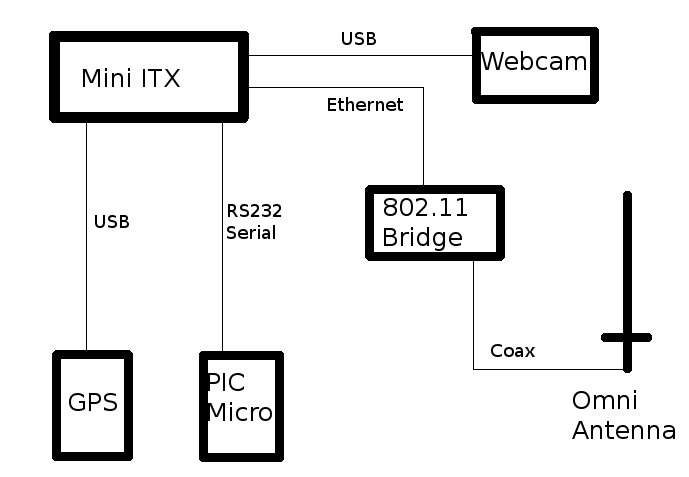
The above diagram show the logic layout of the connections and hardware used for the computer controller.

The Mini-ITX connections use Cat5 to the 802.11 bridge, RS232 to the PIC Micro-controller and USB to the web cam and the GPS.

The 802.11 bridge is also connected to an antenna with shielded coaxial cable.

The choice of operating system for this robot project is Gentoo Linux.

I have found this Linux distribution ideal for embedded and custom designed systems.

It is very easy to make live images and small OS footprints with Gentoo Linux.

I have tested Gentoo Linux on Mini-ITX systems before without any issues.
Gentoo Linux Logo - Copyright Gentoo Linux

More to come in the next parts of this project, as we examine the power system, track design, motor systems and software applications required.

Wednesday, July 21, 2010

Australia's Information Security and Cyber-Warfare

Somewhere in Australia stands a building with a group of federal government information security experts peering at flat screens and being fed reports from various sources. Watching for the next big thing to hit the Australian digital shores - from other governments, criminals, terrorists or crackers.

The Australian Department of Defence also thinks about this topic often. Pondering how other governments or terrorist groups might attack or harm Australia's military IT infrastructure and other related assets.

This has become a worrying reality for other countries and our own, as we have seen recently with the Chinese Google hacking issues, and Australian members of parliament having their websites hacked or defaced.

Can we ever can be safe from cyber attacks or similar quasi military actions?
The answer is yes and no at the same time.

Just think about where we are today. Australia is already in a constant state of cyber war - with other governments, military organisations, corporations, individuals and criminals using the Internet constantly searching for information and knowledge they can use against our interests.

Both in Australia and elsewhere, it's an intelligence orgy out there! Fraud, espionage and information collecting are important parts of these cyber-actions.


The real potential of our cyber warfare organisations is not being utilised. There is a focus on protecting the military and government sectors, but we need to be proactive and ready to employ everything from EMP devices, secret back-doors in manufactured hardware, and unmanned drones with electronic jamming/eavesdropping equipment.

In summary, we are fighting and surviving a cyberwar, while at the same time it is hard to estimate the potential damage if the cyberwar was to escalate. This is why the answer to the question of Australia's cyberwar preparedness seems to be "yes and no".

Australia needs to increase its cyberwar preparedness, even if Australia seems to be coping with the problem at the moment. Any new technologies and cyberwar developments can rapidly change the IT security landscape here. This would leave Australia vulnerable very quickly, and without time for our cyber security teams to react in an effective manner.

We are living in strange and uncertain times.

Tuesday, July 20, 2010

Burning the Midnight on Facebook, Youtube and Scribd

Burning the Midnight is now on Facebook and Scribd. Become a fan on Facebook and get updates to our blog and related sites. Or subscribe to our Scribd channel for updates from Burning the Midnight's publishing house.
Facebook blog and updates for Burning the Midnight

Burning the Midnight on Facebook - Burning the Midnight has gone social with Facebook. Join and become a fan of this site.

http://www.facebook.com/pages/Burning-the-Midnight/120631564649418


Burning the Midnight on Scribd - Subscribe and get publishing updates.

http://www.scribd.com/burningthemidnight

Technology slideshows and technical references have also been added to the Burning the Midnight Scribd profile. Including natural capitalism, electronic/electrical references and networking information.


Burning the Midnight on Youtube - Subscribe to get video and media updates.


http://www.youtube.com/user/luckbenjamin 

Get Burning the Midnight Videos from Youtube. There will be new videos going up every month of projects and tutorials. So stay tuned to this channel... 

You tube Media for Burning the Midnight

Saturday, July 17, 2010

WiMAX 5.8Ghz vs Wi-Fi 5.8Ghz in Backhaul and Access Technologies

In today's wireless market, there are numerous  5.8Ghz Wi-Fi based products.

Now wireless equipment vendors are releasing 5.8Ghz versions of their WiMAX products.

It's tempting for small/medium ISP, businesses and governments to look at the new product offerings, but is it worth the switch to WiMAX from widely used Wi-Fi based products?

Parabolic Antenna

What is Wi-Fi and WiMax?

When comparing technologies for deployment applications, defining exactly what we are looking at is a good place to start.

Wi-Fi Definition:
Wi-Fi (pronounced /ˈwaɪfaɪ/) is a trademark of the Wi-Fi Alliance used with certified products that belong to a class of wireless local area network (WLAN) devices based on the IEEE 802.11 standards.

Because of the close relationship with its underlying standard, the term Wi-Fi is often used as a synonym for IEEE 802.11 technology, including the 802.11a/802.11b/802.11g standards.

WiMAX Definition:
WiMAX, means Worldwide Interoperability for Microwave Access.

It is a telecommunications technology that provides wireless transmission of data using a variety of transmission modes, from point-to-multipoint links to portable and fully mobile Internet access.

The technology provides up to 10 Mbps broadband speed without the need for cables.

It is based on the IEEE 802.16 standard (also called Broadband Wireless Access). The name "WiMAX" was created by the WiMAX Forum, which was formed in June 2001 to promote conformity and interoperability of the standard.

WiMAX and Wi-Fii standards
 Standard
Family
Use
Radio/RF
Down Link
Uplink
Wi-Fi
802.11a/b/g
(11n)
Fixed Internet/Fixed Data services
OFDM/MIMO
TDD
288.9
Can support 600Mbps @ 40MHz channels
WiMAX
802.16d
802.16e
 (802.16m developmental)
Fixed/Mobile Internet/Data services

OFDMA
MIMO-SOFDMA
TDD and FDD 
144
35

As we can see from the standards information, there are distinct differences in both the WiMAX and Wi-Fi technologies and their possible applications.


Can 5.8GHz WiMAX can compete with 5.8GHz Wi-Fi for a Point to Point application?

For point to point applications, 5.8 Wi-Fi works fairly well and is widely used in Australia.

Wifi Logo

The main advantage in the WiMAX standard for PTP networks is FDD (full duplex communications) and QoS features.

But, in many instances, it is difficult for point to point WiMAX to compete with 802.11 Wi-Fi in point to point systems.

Wi-Fi has a better overall data-rate then WiMAX.

In the future, the 802.16m stardard for WiMAX will give point to point systems a better advantage over Wi-Fi point to point systems, offering rates at least 4x the current 802.16e rates.

5.8GHz Point to Multi-Point - WiMAX or Wi-Fi?

The WiMAX standard has many advantages over 802.11 Wi-Fi products in point to multipoint applications.

The hidden node effect is the biggest problem for Wi-Fi networks.

Hidden nodes in a wireless network refer to nodes that are out of range of other nodes or a collection of nodes.

Take a physical star topology with an access point and many nodes surrounding it in a circular fashion. Each node is within communication range of the AP, but some nodes may not be able to communicate with each other, as they do not have a physical connection to each other, thus producing a situation where nodes can not sense the carrier on the network.

Carrier sense multiple access with collision avoidance (CSMA/CA) does not work and collisions occur, scrambling data.

WiMax Logo
The Wi-Fi RF timing is less robust for long range transmissions and systems that have fixed the Wi-Fi timing problems risk incompatibility problems with the 802.11 standards.

There are different versions of 802.11 from vendors including Alverion, Airaya and Skypilot.

These companies use products with modified 802.11, but they only work with their own client subscriber units.

WiMAX wins hands down, and was designed to fix shortfalls in the Wi-Fi standard.

I have tried deploying larger Wi-Fi last mile access networks in the past and experienced a lot of problems.

I have never had a problem with WiMAX network deployments and reliability in access networks.

Saturday, July 10, 2010

Welcome to Burning the Midnight Blog

Hi all Websheeple.

Welcome to Burning the Midnight blog, were myself and other technical friends will be updating you about our projects and eccentric ideas.

Focusing on technical topics, including electronics, information technology, security, automation and cybernetics, Burning the Midnight blog is a hive of practical and useful experimentation, and free information.

Enjoy the site.

From
Benjamin Luck @ Burning the Midnight